

House Extension Architect Melbourne: Your Complete Guide
Planning permits, costs, design decisions and the architectural process for extending a Melbourne home.
Key Takeaways
- Since September 2025, most single dwelling extensions on lots of 300 m² or more in residential zones no longer require a planning permit under Amendment VC282.
- A ground floor house extension in Melbourne typically costs $2,800 to $4,500 per m², while a second storey addition ranges from $3,800 to $6,500+ per m² depending on design complexity.
- Heritage, Design and Development, and other overlays can still trigger a planning permit regardless of lot size or zone.
- Engaging a house extension architect Melbourne homeowners can rely on early in the process reduces risk, avoids costly redesigns, and typically saves more than the fee through better documentation and construction outcomes.
- The full architectural process for a house extension follows five stages: feasibility, schematic design, design development, documentation, and contract administration.
Introduction
Finding the right house extension architect Melbourne homeowners can trust is one of the most consequential decisions in a residential building project. Whether the goal is a new kitchen and living area at the rear, an additional bedroom, or a full second storey, the architect shapes the planning, design and construction outcomes. This guide covers the key questions homeowners face: permit requirements under current Victorian legislation, realistic home extension cost in Melbourne for 2025 to 2026, the differences between single-storey and two-storey additions, and how architects manage the process from first meeting to handover.
Melbourne's housing stock spans Victorian weatherboards, Edwardian cottages, postwar brick veneers and 1970s split-levels. Each type presents different structural, spatial and regulatory challenges. A well-designed extension responds to the character of the existing home while meeting modern standards for energy performance, natural light and liveability. The information below draws on current planning regulations, published cost data and practical experience delivering residential extensions across Melbourne's inner and middle suburbs.
Do you need a planning permit for a house extension in Victoria?
The answer depends on the size of the lot, the zoning, and whether any planning overlays apply. Victorian planning rules changed significantly on 8 September 2025 with the introduction of Amendment VC282. This reform simplified the permit process for extensions to single dwellings on standard residential lots.
The VC282 changes explained
Under Amendment VC282, an extension to a single dwelling on a lot of 300 m² or more in the General Residential Zone (GRZ), Neighbourhood Residential Zone (NRZ) or Township Zone (TZ) generally no longer requires a planning permit. The extension must still comply with the building regulations and relevant ResCode standards, but the planning permit step is removed for qualifying projects.
For lots under 300 m², a planning permit is still required. These applications are assessed against Clause 54 (one dwelling on a lot) of the Victorian Planning Provisions, which covers setbacks, site coverage, overlooking, overshadowing and other amenity standards.
Even on lots of 300 m² or more, a planning permit may still be required if the property is affected by a Heritage Overlay (HO), Design and Development Overlay (DDO), Significant Landscape Overlay (SLO), or other site-specific overlays. Always check the relevant planning scheme before assuming an exemption applies. Any experienced house extension architect in Melbourne can confirm whether overlays affect a specific property.
Permit pathways and timeframes
Where a permit is required, two pathways are available. The VicSmart pathway applies to straightforward, deemed-to-comply applications and provides a decision within 10 business days. Standard planning permit applications have a statutory timeframe of approximately 60 days, though the real-world average across Melbourne councils sits closer to five months when advertising periods, requests for further information and amended plans are factored in.
For a detailed breakdown of Victoria's planning permit process, including how to prepare a strong application and what to expect at each stage, see the planning permit guide.
A house extension is rarely just about adding space. It is about rethinking how the whole home works.
How much does a house extension cost in Melbourne?
Extension costs vary widely depending on the scope of work, the quality of finishes, the complexity of the existing structure, and whether the project involves a ground floor addition or a second storey. The figures below reflect Melbourne market conditions for 2025 to 2026 and are based on completed projects and current builder pricing.
Cost per square metre
| Extension Type | Cost Range (per m²) |
|---|---|
| Ground floor extension | $2,800 to $4,500 |
| Second storey extension | $3,800 to $5,500 |
| Architecturally designed second storey | $5,500 to $6,500+ |
Second storey additions cost more per square metre because they require structural strengthening of the existing ground floor, temporary weatherproofing during construction, and more complex scaffolding and site management. An architecturally designed second storey sits at the upper end because it typically involves bespoke detailing, higher-performance glazing, and more considered integration with the existing roofline and facade.
Typical project cost ranges
| Project Scope | Approximate Size | Total Cost Range |
|---|---|---|
| Small rear extension | 20 to 30 m² | $80,000 to $150,000 |
| Medium extension | 40 to 60 m² | $150,000 to $300,000 |
| Large extension or second storey | 80 to 120 m² | $350,000 to $650,000+ |
These ranges include construction costs but exclude professional fees, council fees, and contingencies. Architectural fees for a house extension typically sit between 10% and 15% of the construction cost, covering all stages from concept design through to contract administration. A detailed breakdown of architectural fees and what they include is available in the architect cost guide.
What drives cost variation?
The biggest factors influencing the cost of a home extension in Melbourne are site access (narrow side setbacks increase construction difficulty), soil conditions (reactive clay is common across Melbourne's inner suburbs), the extent of demolition and structural modification to the existing home, and the specification of finishes, joinery and fixtures. Projects that involve relocating wet areas (kitchens, bathrooms, laundries) also carry higher costs due to plumbing and drainage requirements.
Allowances for unknown conditions are essential. Older Melbourne homes frequently reveal issues during construction, such as inadequate footings, deteriorated framing, or asbestos-containing materials. Thorough site investigation and well-documented projects minimise the risk of costly variations.
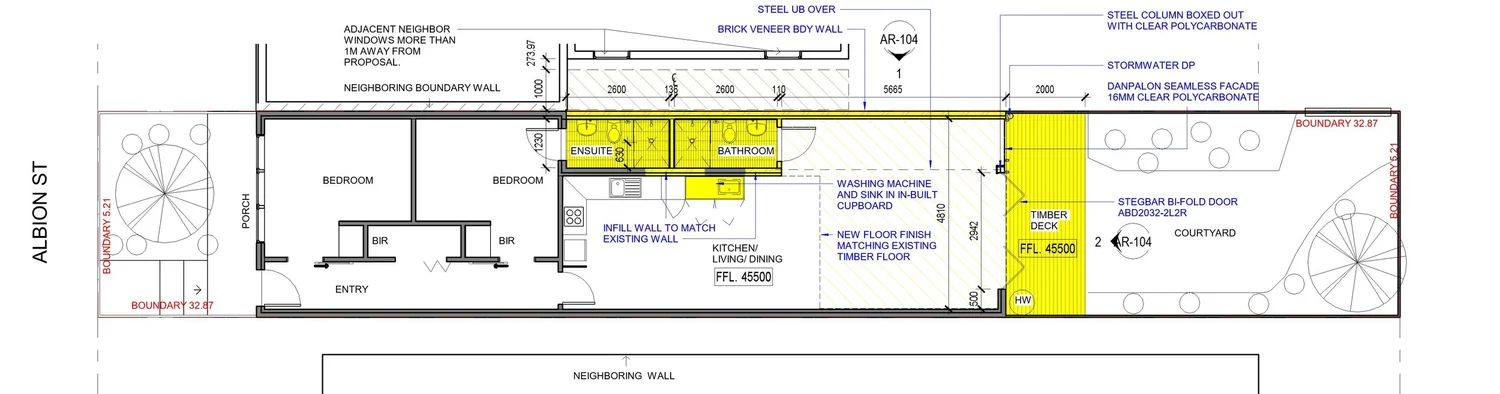 Proposed plan, 209 Albion Street, Brunswick. New living spaces connect to the existing period home via a glazed link corridor.
Single-storey vs two-storey extensions
The single storey vs two storey extension question is one of the earliest decisions in any house extension project. Both approaches have distinct advantages, and the right answer depends on the site, the budget, and what the household needs from the additional space.
Single-storey extensions
A single-storey rear extension is the most common type of house extension in Melbourne. It typically involves demolishing part of the existing rear and constructing a new open-plan kitchen, living and dining area that opens onto the garden. This approach is structurally simpler, less expensive per square metre, and causes less disruption during construction. For families with young children or residents with limited mobility, keeping all living spaces on one level has practical long-term benefits.
The trade-off is site coverage. Building outward consumes garden space, which can be a significant constraint on smaller lots. On a standard inner-suburban block of 300 to 400 m², a ground floor extension of 50 to 60 m² will noticeably reduce outdoor area. Careful planning of courtyard spaces, decks and landscaping can offset this, but the constraint is real.
 209 Albion Street, Brunswick. The single-storey extension includes a timber deck and courtyard to maintain outdoor amenity on a compact site.
Two-storey extensions
A second storey addition preserves garden space and provides clear separation between living zones (ground floor) and sleeping zones (upper floor). This approach is common in Melbourne's middle-ring suburbs where families have outgrown a three-bedroom home but do not want to sell.
The challenges are structural and regulatory. Adding a second storey requires the existing ground floor to carry the additional load, which may mean underpinning footings, reinforcing walls, or installing new steelwork. During construction, the roof is removed and the home is temporarily exposed to weather, requiring careful staging.
From a planning perspective, two-storey extensions trigger more scrutiny around overlooking, overshadowing and visual bulk. Even where a planning permit is not required under VC282, the building must comply with the relevant standards. Where a permit is required, neighbour objections are more common for two-storey additions than for single-storey rear extensions.
Some projects combine a ground floor rear extension with a partial upper-level addition above the existing footprint. This can be an effective way to gain both a new open-plan living area and an additional bedroom or study without consuming all the available garden space or creating excessive visual bulk when viewed from neighbouring properties.
Working with your existing home's character
Melbourne's residential character is defined by its period housing stock. Victorian terraces, Edwardian weatherboards, interwar bungalows and mid-century brick homes each carry distinct proportions, materials and detailing. A successful house extension does not try to replicate the original architecture or ignore it. It finds a coherent relationship between old and new.
Respecting the street presentation
Most Melbourne house extensions are designed to be invisible from the street. The front rooms are retained, and the extension is built at the rear, set back from the primary facade. Where a Heritage Overlay applies, this is typically a condition of the planning permit. Even where no overlay exists, retaining the street presentation respects neighbourhood character and protects resale value.
The connection between old and new
The junction between the existing home and the new extension is the most critical design decision. A recessed or glazed link can provide a clear visual separation between the two, allowing each to read as a distinct element. At 209 Albion Street in Brunswick, Dadirri Architects used a glazed link corridor with a polycarbonate clerestory to connect the existing front bedrooms to the new kitchen, living and dining spaces at the rear. This approach allows natural light to flood the transition zone and provides a legible reading of where the original home ends and the extension begins.
Material choices
Material selection is a powerful tool for managing the relationship between old and new. The extension can match the existing materials (brick to brick, weatherboard to weatherboard) for a seamless appearance, or it can introduce a contrasting but complementary material palette. Common approaches in Melbourne include pairing an existing brick home with a timber-clad or metal-clad extension, or combining rendered masonry with zinc or Colorbond cladding.
The 209 Albion Street project uses brick veneer boundary walls that reference the materiality of the surrounding Brunswick streetscape while introducing a contemporary form and fenestration pattern. This kind of considered material response is central to how an architect approaches a house extension.
 Material detail, 209 Albion Street. Brick veneer references the existing streetscape while the glazed link reads as a distinct contemporary element.
Internal flow and spatial planning
Beyond appearance, a house extension must resolve how people move through the home. Period homes in Melbourne were typically planned as a series of discrete rooms connected by a central corridor. Modern living patterns favour open-plan spaces with direct access to outdoor areas. The challenge is bridging these two spatial logics without creating awkward transitions or rooms that feel disconnected from the rest of the home.
An experienced architect will map circulation patterns early, testing how the household moves between kitchen, living, dining, outdoor, sleeping and utility areas throughout the day. This analysis often reveals that the most valuable design moves are not about adding space but about reconfiguring how existing space is used.
The best extensions feel as though they have always been part of the home, even when the architecture is clearly contemporary.
How the architectural process works for extensions
Working with a house extension architect in Melbourne follows a structured process that manages complexity, reduces risk and gives homeowners control over design and cost decisions at each stage. Most residential architecture practices follow five stages, each building on the last.
1. Feasibility and site analysis
Before any design work begins, the architect assesses what is realistically achievable on the site. This includes reviewing planning controls (zoning, overlays, setback requirements), measuring the existing home, understanding the structural system, and discussing the household's needs, priorities and budget. The output is a clear picture of what is possible, what requires a planning permit, and the likely cost range.
2. Schematic design
The schematic design phase explores layout options and spatial strategies. The architect develops two or three concept plans that test different approaches to the extension, such as a ground floor only option versus a partial upper level, or a wide rear extension versus a narrower side extension. Plans, sections and 3D views allow the client to understand how each option affects light, views, garden space and budget. A preferred direction is selected by the end of this stage.
3. Design development
The selected concept is developed in detail. Materials, window and door locations, kitchen and bathroom layouts, structural systems and services coordination are resolved during this phase. If a planning permit is required, the application drawings are typically prepared at this point. The design is refined through review meetings until the client is confident that every aspect has been considered.
4. Documentation
Full construction documentation includes detailed drawings, schedules and specifications that a builder needs to price and construct the project accurately. Thorough documentation is the single most effective tool for controlling cost and quality. Incomplete or ambiguous documents are the primary cause of budget blowouts and disputes during construction.
Builders price what they see in the drawings and specification. Where documents are vague or incomplete, builders either exclude items (leading to costly variations) or add generous allowances (inflating the tender price). A well-documented set from an experienced architect typically saves more in avoided variations and competitive pricing than the cost of the additional documentation time.
5. Tendering and contract administration
The architect assists with selecting builders, managing the tender process, and recommending a preferred contractor. During construction, the architect conducts site inspections, reviews progress claims, assesses variations, and acts as the client's representative. This oversight ensures the project is built in accordance with the approved design.
The entire process typically takes 12 to 18 months for a straightforward single-storey extension, and 18 to 24 months where a planning permit or second storey is involved.
Frequently Asked Questions
How long does a house extension take from start to finish in Melbourne?
A typical single-storey house extension takes 12 to 18 months from first design meeting to construction completion. This includes four to six months for design and documentation, one to five months for planning approval (if required), one to two months for tendering, and five to eight months for construction. Second storey additions generally take 18 to 24 months or longer.
Can homeowners live in the house during a house extension?
For most single-storey rear extensions, homeowners can remain in the home during construction, though there will be periods of significant disruption including noise, dust and restricted access to certain rooms. For second storey additions, it is often advisable to move out during the structural and roofing phases, which typically last six to 10 weeks. The architect and builder can advise on the specific logistics for each project.
Does a house extension add value to a Melbourne property?
A well-designed extension generally adds significant value, particularly in Melbourne's established suburbs where land values are high and buyers pay a premium for renovated homes. The value added depends on design quality, construction standard, and how well the extension integrates with the existing home. An architecturally designed extension that improves the floor plan, increases natural light and connects indoor and outdoor spaces typically delivers a stronger return than a basic builder-led addition.
What is the difference between a building permit and a planning permit for a house extension?
A planning permit is issued by the local council and addresses land use, neighbourhood character, amenity impacts and compliance with the planning scheme. A building permit is issued by a registered building surveyor and covers structural adequacy, fire safety, energy efficiency and compliance with the National Construction Code. Most house extensions require a building permit regardless of whether a planning permit is needed. The two processes run in parallel but are assessed by different authorities.
How much does an architect charge for a house extension in Melbourne?
Architectural fees for a house extension typically range from 10% to 15% of the construction cost, depending on the scope of services and the complexity of the project. For a $300,000 extension, this equates to approximately $30,000 to $45,000 for full services from concept design through to contract administration. Some architects offer partial services (design and documentation only) at a lower fee. A full breakdown of architectural fee structures is available in the architect cost guide.
Do all house extensions in Melbourne need a planning permit after VC282?
No. Since Amendment VC282 took effect on 8 September 2025, single dwelling extensions on lots of 300 m² or more in the General Residential Zone, Neighbourhood Residential Zone or Township Zone generally do not require a planning permit. However, a permit is still required for lots under 300 m², and properties affected by Heritage Overlays, Design and Development Overlays or other overlays may still require a permit regardless of lot size.
Should a house extension match the existing home or look different?
There is no single correct approach. Some extensions replicate the materials and forms of the existing home for a seamless appearance. Others introduce a clearly contemporary design language that contrasts with the original building. Both approaches can be successful when handled skilfully. The most common strategy for period homes in Melbourne is to retain and restore the front of the home while designing a contemporary extension at the rear, with a clear transition element (such as a glazed link) between old and new.
What are the most common mistakes homeowners make with house extensions?
The most frequent issues are underestimating the budget (particularly for hidden structural work in older homes), skipping the feasibility stage, starting construction with incomplete documentation, and choosing a builder solely on price rather than capability. Failing to consider how the extension affects natural light and ventilation to existing rooms is also common. Engaging a qualified architect early addresses most of these risks before they become costly problems.
References
- Victorian Government, Amendment VC282: Reforming Residential Zones, Department of Transport and Planning, 8 September 2025. planning.vic.gov.au
- Victorian Planning Provisions, Clause 54: One Dwelling on a Lot, Department of Transport and Planning. planning-schemes.app.planning.vic.gov.au
- Australian Institute of Architects, A Client's Guide to Engaging an Architect, 2024.
- Housing Industry Association, HIA Housing Scorecard: Victoria, Q4 2025.
- Rawlinsons, Australian Construction Handbook, Edition 43, 2025.
Considering a House Extension?
We help Melbourne homeowners design extensions that respect the character of their existing home while creating spaces that work for how they live today. Get in touch to discuss your project.
Start a ConversationNot ready to talk yet?
Explore our other guides to understand the planning process and what an architect costs in Melbourne.
Browse All Guides